

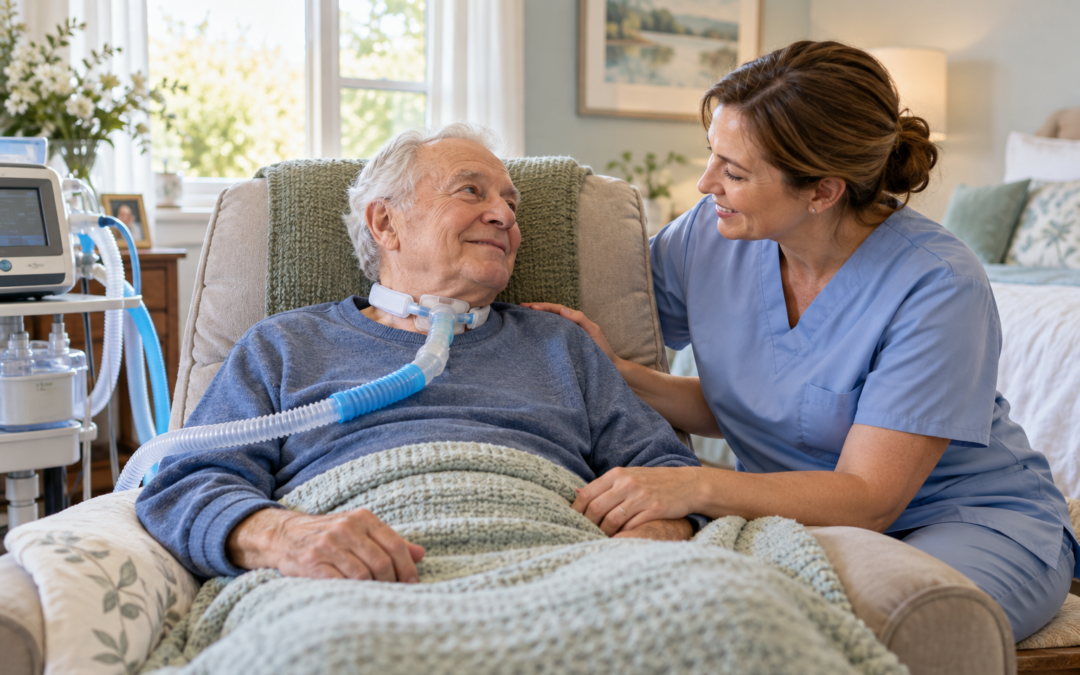
Finding the right setting for someone who uses a ventilator or has a tracheostomy can be overwhelming. Families may be moving from an intensive care unit, rehabilitation hospital, or long-term acute care hospital and wondering what comes next. The goal is not simply to find an available bed. It is to find a setting that can safely support complex respiratory needs while preserving dignity, comfort, relationships, and daily life.
Some people who need ventilation for an extended period remain in long-term care, while others may live in a community-based setting when appropriate clinical support is available. Every person’s needs are different, and placement decisions should be made with the individual, family, hospital team, respiratory therapist, and medical providers.
What long-term ventilator and tracheostomy care involves
A mechanical ventilator assists or takes over part of the work of breathing when a person cannot breathe adequately on their own. A tracheostomy is a surgically created opening in the neck that provides access to the airway. Some people with a tracheostomy breathe independently, while others require ventilator support for part or all of the day.
Long-term care may include respiratory assessment, ventilator monitoring, tracheostomy care, suctioning when clinically indicated, medication administration, nutrition support, skin protection, mobility assistance, and communication with physicians and respiratory therapists. The exact plan must be based on current medical orders and the resident’s individualized care plan.
Six things families should evaluate
1. Staff training and clinical oversight
Ask who is present during the day and overnight, what respiratory-care training staff receive, and how changes in condition are recognized and escalated. Families should understand who communicates with the primary provider, respiratory therapist, pharmacy, durable medical equipment company, and hospital team.
2. Emergency preparation
Ventilator and tracheostomy care requires a written emergency plan. Ask about backup power, manual ventilation equipment, spare tracheostomy supplies, emergency medications when ordered, alarm response, and the process for contacting emergency services. Equipment and backup plans should match the person’s prescribed needs.
3. Airway and equipment care
Safe care includes following the prescribed schedule for tracheostomy care, equipment checks, humidification, circuit and supply management, and infection-prevention practices. Suctioning and airway-clearance procedures should be performed according to the care plan by people trained to recognize signs of distress.
4. Nutrition, swallowing, and hydration
A tracheostomy can affect swallowing and communication differently from one person to another. Some residents eat by mouth, while others receive nutrition through a feeding tube or use a combination of methods. A speech-language pathologist, dietitian, and medical team may help determine the safest plan. Families should ask how dietary needs, hydration, weight, and feeding-tube care are monitored.
5. Skin protection and mobility
People with limited mobility may be at increased risk for pressure injuries, stiffness, discomfort, and loss of function. A strong care plan addresses repositioning, skin assessment, appropriate support surfaces, range-of-motion activities, transfers, and therapy recommendations while respecting the resident’s tolerance and goals.
6. Quality of life
Complex medical needs do not erase a person’s need for privacy, meaningful relationships, spiritual support, familiar routines, fresh air, music, conversation, and personal choice. Ask how the setting supports ordinary life—not only medical tasks. A smaller home environment may feel less institutional and may allow care to be organized around the resident rather than around a facility schedule.
When a specialized adult family home may be appropriate
A specialized adult family home may be considered when the person is medically stable enough to leave acute care but still needs substantial daily assistance and respiratory support. Suitability depends on the individual’s ventilator settings, airway needs, medications, nutrition plan, behavioral and mobility needs, emergency risks, and the home’s staffing and licensing capabilities.
Before accepting a placement, the home should complete a careful assessment and obtain current orders, equipment information, medication lists, recent clinical notes, and emergency instructions. Families should be invited to ask questions and should receive a clear explanation of what the home can and cannot provide.
Questions to ask during a tour or assessment
- Who will provide hands-on care during each shift?
- How are ventilator alarms and respiratory changes handled?
- What is the backup-power and equipment plan?
- How does the home coordinate with respiratory therapy and medical providers?
- How are nutrition, skin integrity, mobility, and communication needs addressed?
- What happens if the resident’s condition changes?
- How are family involvement, personal preferences, and spiritual needs supported?
A home-like approach in the Vancouver-Portland area
Sacred Life Care provides a small, home-like setting in Vancouver, Washington, for adults with complex care needs, including ventilator and tracheostomy support. Our approach combines nursing oversight, individualized care, coordination with the resident’s healthcare team, and respect for the whole person.
Families and discharge planners can learn more on our Care We Provide page or contact Sacred Life Care to discuss whether a prospective resident’s needs may be appropriate for assessment.
Trusted resources
- MedlinePlus: Learning About Ventilators
- MedlinePlus: Tracheostomy Care
- American Thoracic Society: Living With a Tracheostomy
- American Association for Respiratory Care: Long-Term Invasive Mechanical Ventilation in the Home
This article is for general educational purposes and does not replace individualized medical advice, medical orders, or emergency care.