

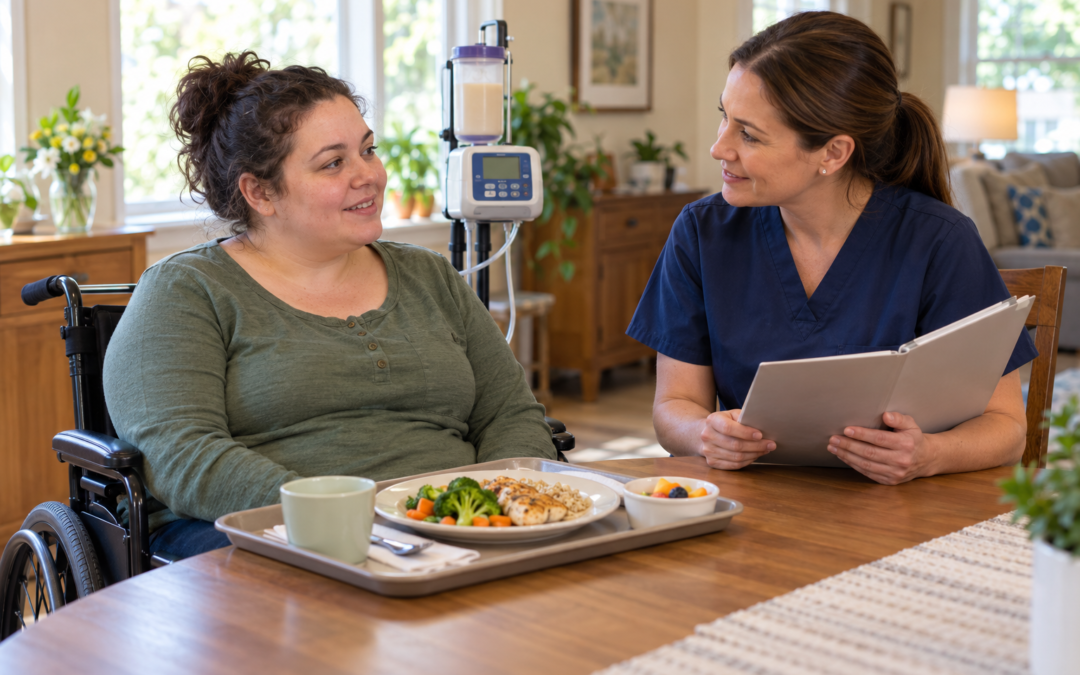
Illustrative image. Nutrition and swallowing plans should be tailored to each person.
Families looking for an adult family home in Vancouver, WA often have questions about nutrition and tube feeding. Those questions matter when a loved one needs help with meals, nursing support, ventilator care, or tracheostomy care.
Every life is sacred. Stewarding the care of life means giving thoughtful attention to the whole person: their body, feelings, beliefs, relationships, and wishes. A nutrition plan should respect both medical needs and what matters to the person receiving care.
Here are simple questions to help families and hospital discharge planners talk about meals, swallowing, and tube feeding.
Start with the person and their wishes
Begin by asking your loved one what matters to them. Which foods feel familiar? Do they prefer company or quiet? Are there cultural or faith traditions they want to keep?
Someone who receives tube feeding still deserves choice, connection, and a place in family life. Ask how shared time can fit their comfort and care plan. Welcome their feelings about changes in eating, and give them room to ask questions.
Spiritual care should follow the person’s wishes. Prayer may be meaningful to one person, while another may prefer a quiet moment or a conversation. Listening is part of caring for the whole person.
Notice changes in eating and weight
Malnutrition means the body is not getting enough energy or the right balance of nutrients. People with long-term illness may be at higher risk. Trouble swallowing, digestive problems, and some medicines can affect eating. [1]
Tell the care team about weight loss that was not planned, weakness, slow healing, or changes in appetite. These signs do not prove a nutrition problem, and some people have no clear signs. A healthcare professional can assess what is happening. [1]
Ask who checks nutrition needs and whether a registered dietitian can help when needed. Share what you notice, including meals that take longer than usual and foods your loved one enjoys.
Follow the swallowing plan
Trouble swallowing is also called dysphagia. Signs can include coughing or choking around meals, throat clearing, slow eating, or weight loss. Report concerns to the care team. [2]
Follow the person’s written instructions for food texture, drinks, seating, and help with eating. Do not change food textures or offer thin liquids without checking with the clinician or swallowing therapist. Even a favorite drink may need a different preparation. [2]
Ask how staff and visiting family members will learn the same plan. Make sure you know whom to contact if swallowing becomes harder or coughing develops around meals.
Understand why tube feeding is being used
Tube feeding, also called enteral nutrition, sends nutrients into the stomach or small intestine. A healthcare professional may recommend it when a person cannot eat or drink enough to meet their needs. Tube feeding outside a hospital is called home enteral nutrition. [3]
Different tubes and feeding methods meet different needs. The healthcare professional helps the person choose the right approach. A tracheostomy alone does not tell you what nutrition plan is right for someone.
Ask the hospital team to explain the plan in everyday words:
- What type of feeding tube does my loved one have?
- Does the plan allow any food or drinks by mouth?
- Who reviews the nutrition plan as needs change?
Use the person’s current orders when discussing care with a home. Do not assume that everyone with a feeding tube has the same needs.
Ask who will support the feeding plan
Mayo Clinic describes a team approach to home tube feeding. Its program includes nurses, dietitians, doctors, and other specialists. Training covers formula, tube care, supplies, and records, with follow-up after training. [4]
When comparing local care options, ask:
- Who follows the prescribed formula and feeding schedule?
- How are supplies ordered and kept available?
- Who should we contact about discomfort, feeding problems, or concerns around the tube site?
- How will the treating clinician receive updates and approve changes?
Before a move, the hospital team and receiving home should discuss the current orders and follow-up contacts. Feeding rates, water amounts, and tube-care steps must come from the person’s clinical instructions. Families should ask the care team for help with unfamiliar equipment.
Discuss whole foods without changing treatment on your own
Mark Hyman, MD, encourages whole or minimally processed foods and nutrition choices tailored to each person. His perspective can prompt useful questions about food. It does not prove that a diet reverses a person’s condition or replaces prescribed treatment. [5]
For someone with a feeding tube, interest in whole foods is a reason to speak with the treating clinician and dietitian. Do not replace prescribed formula on your own.
Mayo Clinic lists a study of blenderized tube feeding in adults. When checked on October 7, 2026, the listing was closed for enrollment and had no publications available. The listing does not show that blended food works better than standard formula. [6]
If you are interested in a food-based formula, ask whether it fits your loved one’s needs and what preparation and monitoring would be required.
Bring the whole picture to a care conversation
When speaking with Sacred Life Care or another Vancouver-area provider, bring the current nutrition and swallowing plans. Also share the person’s routines, concerns, beliefs, and wishes. Ask which needs the home can meet and how it will work with the treating team.
You can learn about Sacred Life’s care services and contact the team to discuss your loved one’s needs.
Good stewardship calls for careful listening, clear plans, and respect for each person’s dignity. Whether nourishment comes through a meal or a feeding tube, the person receiving care should remain at the center of the conversation.
This article is for general education. Nutrition and swallowing decisions should follow the person’s healthcare plan and guidance from their care team.
Sources
- MedlinePlus: Malnutrition
- MedlinePlus: Swallowing problems
- Mayo Clinic: Home enteral nutrition
- Mayo Clinic: Home enteral nutrition care
- Mark Hyman, MD: Office Hours, What Should I Actually Eat? This is a clinician’s perspective, not a tube-feeding treatment guideline.
- Mayo Clinic: Study of blenderized tube feeding in adults This is a study listing, not a published report of results.
Recent Comments